
The Intro
Secret Oath. The 2-cost, utility spell that steals power 4 mana cards and wrecks spell repertoires. We’ve all been in the spot of building a repertoire that takes advantage of using power 4 mana cards only to see Secret Oath peel off the top of the deck for our opponent to snag and force us to either retool on the fly or run the repertoire sub-optimally. But is it overpowered? I claimed as an individual card it is the strongest single card in this video, and here I demonstrated how you can set up a combo that prevents your opponent from having mana. From the discord server to the forums of BGA and BGG the topic of Secret Oath’s power comes up frequently.
I’ve had a number of games recently where the person who got Secret Oath just ran away with the game with little the other player could do about it.
–Dan Jenkinson, BGA
It’s completely busted to the point where there are multiple ways to keep your opponent from having a turn while it is active.
–SolaireLight, BGA
I haven’t yet played too many games, but looks like the secret oath card is way more powerful.
–@WonderWoman_, BGG
This card is bustedo.
–JoeB, Discord
With all that in mind, I wanted to look at the statistical win rate of players taking Secret Oath. Is it actually overpowered or does it merely lead to a negative play experience (NPE) when you can’t play around it?
The Method
I pulled data from The Weekly tournaments Stage 2, weeks 1 through 4 from BGA. There were a total of 112 games played. One game had a corrupted replay with no data. Four games were not completed within the allowed time and were forfeited. These games were not included in the results, leaving 107 games to be reviewed. I chose to review games in stage 2 of tournaments because it is a competitive setting and these players advanced from the group stage and should be on a more consistent playing level with each other.
The Question
The main question for this data dive is “Does having Secret Oath lead to more wins in a competitive setting”?
The Findings
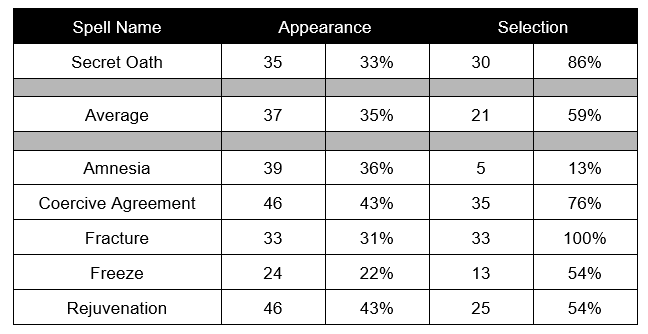
The card pool in The Weekly tournaments was set to the base game and 10-card Lost Pages expansion for a total of 70 cards. The number of spells revealed each game ranged from 21 to 30 with an average of 24.32 spells revealed. Based on these numbers, the chance of any individual spell coming into the Spell Pool to be selected ranges from 30% to 43%; with a 34% chance at the average number of spells revealed. Secret Oath was available to be selected in 35 games or roughly 33% of games. The occurrence of other cards ranged from 24 (22%, Freeze) to 46 (43%, Coercive Agreement and Rejuvenation) with 37 being the average number of appearances. Secret Oath was selected from the spell pool 30 times for a selection rate of 86%. The selection rate of all cards ranged from 13% (Amnesia, 5 of 39) to 100% (Fracture, 33 of 33). Three cards were selected at a higher rate than Secret Oath; Fracture (100%), Time Distortion (91%), and After Shock (90%).
For all games reviewed, the “Chooses First” player won 46 of the games (43%) with the “Attacks First” player winning 61 (57%). This ratio differs slightly from the near 50/50 win rate for all games played on BGA. The selection of Secret Oath was nearly equal between player starting position; it was selected by the “Chooses First” player 16 times and the “Attacks First” player 14 times. The “Chooses First” player won 5 (31%) of their games with Secret Oath and the “Attacks First” player won 8 (57%) of their games with Secret Oath. Total wins for players selecting Secret Oath were 13 of 30 games (43%). The other top selected spells had win rates of 65% (Time Distortion), 52% (Fracture), and 48% (After Shock).
The Conclusion
Overall, a player simply having Secret Oath in their repertoire did not seem to dictate the outcome of the game. The win rate for players with Secret Oath was at or below the average win rate for player position for these events, it was the lowest win rate of the top selected spells, and it was below the expected overall BGA win rate. While Secret Oath combos with and counters against many cards it does not seem to be a silver bullet for victory. I believe there are a few reasons this card sticks out as problematic to players:
1) it is one of the few spells that directly attack players hand of mana cards
2) NPE when losing full turns due to no mana draw against certain combos
3) the interactions with Secret Oath are more memorable than other cards
I believe a combination of these makes the interactions stand out to people. Compare these points to Time Distortion and the results from the same data set. Time Distortion is a very strong utility card, but it does not attack the hand, it does not create an NPE situation, and is generally not memorable with its interactions, but it has a very high win rate.
The Limitations
There are some limitations of this data dive that I may revisit in the future. Most importantly, I did not look at when Secret Oath was selected. I assume it is much stronger when selected in the first three spells by a player, but additional review would be needed to determine if selection position affects the outcome. Additionally, I did not look at any spell combos created or if spells were “hate drafted”. I believe the outcomes of games are highly driven by effective and efficient spell combos. In this instance, the meta data was more meaningful for the overall value of Secret Oath, but a detailed study of specific combos may show a higher effectiveness for Secret Oath. Furthermore, I did not consider player ELO. While these games were taken from Stage 2, ELO could be a better variable to judge player skill level. Finally, I did not look at the win rate of all spells, but plan to in the near future to see how Secret Oath compares to them.
The(?!) How to Play Against Secret Oath
The general consensus to play against Secret Oath is having multiple regeneration cards and not exhausting your hand of mana cards at the end of your turn. This will allow you to overcome losing cards from your hand and prevent you from ever missing an entire turn.
 Tabletop Railbird